1. Engine Power — Going Beyond the Numbers
Horsepower — abbreviated as hp or PS — is the standard measure of an engine's output. In the Chinese heavy-truck segment, power ratings typically span from 280hp to above 500hp. At a basic level, a higher figure means a more capable engine, but treating "more power" as automatically better is a common misstep.
Horsepower — abbreviated as hp or PS — is the standard measure of an engine's output. In the Chinese heavy-truck segment, power ratings typically span from 280hp to above 500hp. At a basic level, a higher figure means a more capable engine, but treating "more power" as automatically better is a common misstep.
Power Bands and Where They Fit
280–340hp: Well-suited to short and medium-distance freight, routine loads, and predominantly sealed road surfaces. These engines offer stronger fuel efficiency and a lower purchase cost. You will find this power band in mid-spec Foton Auman and HOWO tractor models.
350–400hp: The workhorse range for Chinese heavy trucks. HOWO 371hp and 400hp dump trucks and tractor units sit here. The band covers construction site hauling, mining logistics, and mid-to-long-distance transport. It occupies a sweet spot between pulling power and diesel consumption. For the majority of infrastructure and engineering projects across Africa and Latin America, engines in this bracket are typically more than adequate.
420–500hp+: Built for maximum-weight long-haul duties, mine-site gradient climbing, and oversized cargo movements. HOWO 430hp tractor heads and selected high-output Foton Auman EST variants fall into this category. The power reserve is generous, but fuel burn is correspondingly higher. If your day-to-day workload does not call for this output level, the surplus horsepower simply drives up operating costs without delivering value.
The Core Principle
Power selection should be guided by your dominant operating profile, not by occasional peak demands. When a truck spends the vast majority of its hours cruising flat highways under standard load, there is no justification for a 450hp motor just to handle a rare steep incline. On the other hand, if the fleet works daily on mine gradients or consistently runs at full-rated payload, installing an underpowered engine forces it into permanent high-stress operation — shortening service life and potentially increasing, rather than decreasing, fuel usage.
2. Axle Layout — The Factor That Governs Load and Terrain Performance
An axle layout is written as "number of driven wheels × total wheel ends." Among all the figures on a Chinese truck data sheet, this one is both the most important and the most frequently misunderstood. The wheel-end count defines both how much weight the vehicle can legally carry and how well it maintains traction off sealed roads.
Standard Axle Setups
| Layout | Description | Common Use | Typical Models |
|---|---|---|---|
| 4×2 | 4 wheel ends, 2 powered (single rear drive axle) | Light tipping, city distribution, short-haul freight | HOWO 4×2 mini dump, Foton light trucks |
| 6×4 | 6 wheel ends, 4 powered (twin rear drive axles) | Medium and heavy dump, standard tractor units, site logistics | HOWO 6×4 dump, Shacman F3000 6×4, Foton Auman 6×4 |
| 8×4 | 8 wheel ends, 4 powered (dual front steer axles plus twin rear drives) | Heavy tipping, mining haulage, maximum-weight operations | HOWO 8×4 dump, HOWO TX 8×4 |
| 6×2 | 6 wheel ends, 2 powered (one front axle may function as a lift or tag axle) | Medium-to-long-distance tractor, express logistics | Certain Foton tractor variants |
How to Decide on an Axle Layout
Assess the road surface: For routes that stay on paved highways, 4×2 or 6×2 will do the job. Once the work moves onto construction tracks, mine trails, or unsealed roads, a 6×4 becomes the minimum and 8×4 the more dependable choice. Additional driven wheels translate directly into improved grip on loose or soft ground.
Assess the load: The axle layout sets the legal gross vehicle mass. Taking Chinese norms as a reference point (always verify against the importing country's own rules): a 4×2 generally maps to a gross weight of 16–18 tonnes, 6×4 to 25–31 tonnes, and 8×4 to 31–40 tonnes and above. If the tonnage you haul daily is substantial, an under-spec axle arrangement forces the truck into persistent overloading and accelerates damage.
Verify destination regulations: Axle-weight limits differ from one country to another. Before placing an order, confirm the maximum permitted axle loading and gross vehicle mass in the country where the truck will operate, then reverse-engineer the axle layout you need. An 8×4 dump truck type-approved for 40 tonnes in China might be restricted to 31 tonnes by local legislation.
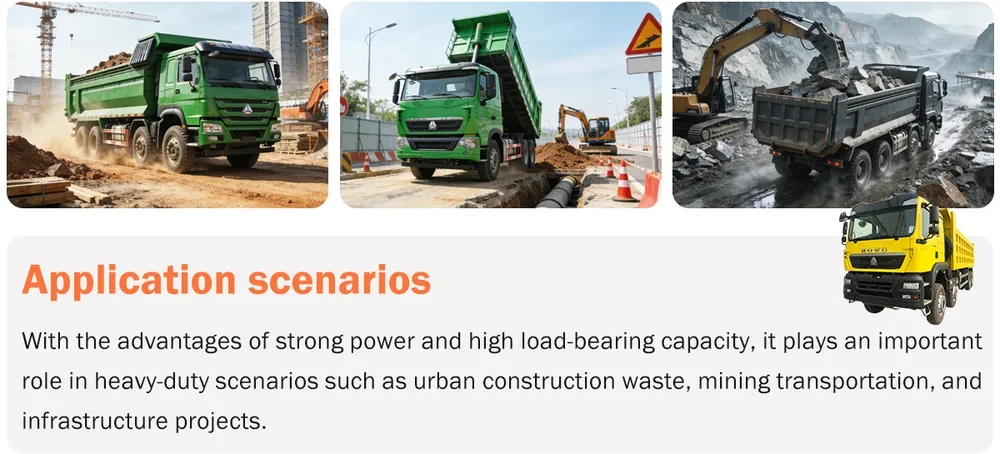
3. Load Ratings — Design Capacity vs What Happens in the Field
Load capacity is another area where confusion is common. Chinese trucks are usually described with two related but distinct figures:
Rated Payload: The manufacturer's certified design capacity, shown on the vehicle identification plate and compliance documentation. This figure represents the engineering limit for safe use under standard road conditions.
Field Capacity: In day-to-day operation, many users run above the rated figure. Chinese truck chassis and frames are typically engineered with substantial safety margins, but sustained overloading dramatically shortens the working life of tyres, suspension components, brake systems, and the frame structure.
Frame Strength Is the Bedrock
Carrying capacity is a function not just of axle count but, critically, of how the chassis is built. A frame made from high-tensile steel absorbs far greater bending and twisting loads before deforming than one made from standard-grade material. Heavy-duty dump models from manufacturers such as HOWO and Shacman routinely employ double-layer or reinforced longitudinal members — which is precisely why they hold up under mining and heavy-haul conditions.
A sensible approach when matching a vehicle to its task: choose a rated capacity that covers your daily real-world payload with roughly a 20% safety buffer, rather than picking a truck whose maximum on-paper figure is barely equal to what you actually carry.
4. Bringing the Three Together — Two Practical Examples
Example One: Urban Demolition and Spoil Removal
Routes are mostly city streets with sealed surfaces. Trips are short. The truck stops and starts frequently. Traction demands are moderate but decent load capacity is still needed. Recommended setup: HOWO 6×4 dump truck, 340–371hp. The 6×4 configuration gives sufficient drive-axle grip, and 340–371hp supplies enough output for short-cycle work while keeping diesel costs under control.
Example Two: Mine Haul Roads with Sustained Climbing
Routes feature extended uphill grades on unsealed or deeply rutted tracks. Trip distances are medium. Both payload weight and traction are critical. Recommended setup: HOWO 8×4 dump truck, 400–430hp. The 8×4 layout secures a higher legal gross mass ceiling plus improved stability. Choosing 400hp or above guarantees the engine maintains pace when pulling a full load uphill.
Summary
The specification system for Chinese trucks is built on clear logic. What matters is examining three variables as a connected set: engine output sets the pace and climbing ability; the axle arrangement defines payload capability and off-highway competence; the load rating determines the structural punishment the frame can endure over its service life. Get the combination wrong, and the outcome is anything from wasted fuel to a write-off.
Africa and Latin America present an enormous variety of operating conditions — one spec cannot cover every project. Aligning power, axle count, and payload precisely with your actual working environment will always outperform chasing either the biggest numbers or the lowest sticker price.
To discuss specifications, build configurations, and delivered pricing for HOWO, Shacman, and Foton dump trucks and tractor heads, reach out to the Shandong Chengda team.